


The History of Barcodes and the Thermal Printers That Helped Power Them

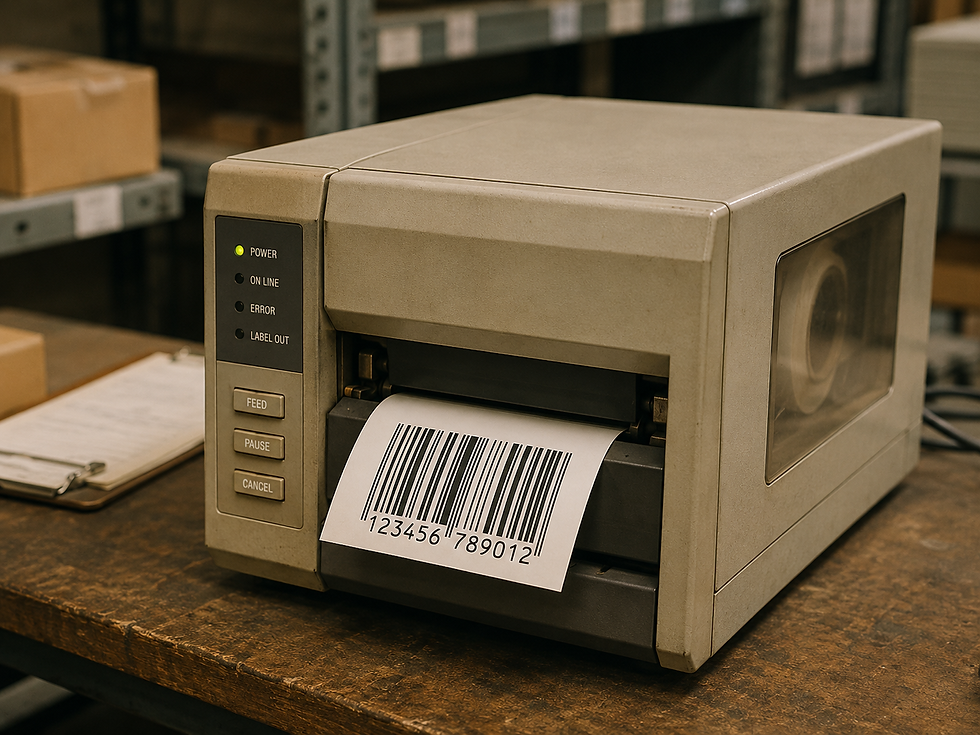
Barcodes are one of those technologies that most people see every day but rarely think about. They are on grocery products, shipping labels, warehouse racks, hospital wristbands, retail tags, food packaging, and just about every box moving through a supply chain.
At first glance, a barcode looks simple: a pattern of black and white lines or squares. But behind that pattern is one of the most important business technologies ever created.
Barcodes changed how products are identified, how inventory is tracked, how packages move, how retailers check out customers, and how companies connect physical items to digital systems. But barcodes did not become powerful on their own. They needed scanners, software, standards, and reliable printing technology.
That is where thermal printers became a major part of the story.
The Problem Before Barcodes
Before barcodes, product identification was mostly manual. Cashiers typed prices into registers. Warehouse workers wrote down part numbers. Inventory counts relied on paper forms, memory, and manual entry. Every step created room for mistakes.
If someone typed one wrong number, picked the wrong item, mislabeled a box, or misread handwriting, the error could move through the entire operation.
The business world needed a better way to identify items quickly and accurately. The barcode became that answer.
The Early Idea: Turning Information Into a Pattern
The barcode concept began in the late 1940s when Bernard Silver and Norman Joseph Woodland started working on a way to automatically identify products. Woodland was inspired by Morse code and imagined stretching dots and dashes into lines that could be read by a machine.
Their original design was not the familiar rectangle of vertical lines we know today. It was a bullseye-style symbol made of concentric circles. Woodland and Silver were issued U.S. Patent 2,612,994 on October 7, 1952, for a “classifying apparatus and method.” The Smithsonian notes that they later sold the patent to Philco in 1961.
At the time, the idea was ahead of the available technology. The concept existed, but scanners, computers, and printing systems were not yet ready to make it practical on a large scale.
The Barcode Goes Commercial
The major breakthrough came in retail.
In the late 1960s and early 1970s, grocery stores were looking for a way to speed up checkout and improve inventory accuracy. The industry needed a common product identification standard that could work across manufacturers, distributors, and retailers.
In 1973, the Universal Product Code, or UPC, was selected as the first major standard for unique product identification. Then, on June 26, 1974, a pack of Wrigley’s Juicy Fruit gum became the first product scanned with a UPC barcode at a supermarket checkout in Troy, Ohio.
That moment was much bigger than a pack of gum. It showed that a product could carry a standardized code, a scanner could read it instantly, and a computer system could connect that code to product information.
That changed retail forever.
Where Thermal Printers Enter the Story
The early barcode world depended heavily on preprinted retail packaging. A UPC could be printed directly on a cereal box, can, bottle, or consumer package during manufacturing.
But as barcode usage expanded beyond retail checkout, companies needed a way to create barcode labels on demand.
A warehouse needed labels for pallets, cartons, and locations.
A manufacturer needed labels for work-in-process and finished goods.
A hospital needed wristbands and lab sample labels.
A shipping department needed tracking labels.
A retailer needed shelf labels, markdown labels, and inventory tags.
This is where thermal printing became essential.
Thermal printers gave companies the ability to print crisp, scannable barcodes at the point of need. Instead of ordering every label in advance from a print shop, businesses could print labels as inventory moved, orders shipped, products were built, or patients were admitted.
Thermal printing became a natural fit because it produced sharp black-and-white images, did not rely on ink cartridges or toner, and could be built into rugged industrial printers for warehouses, factories, retail stores, and logistics operations.
Direct Thermal and Thermal Transfer
Thermal printing generally falls into two categories: direct thermal and thermal transfer.
Direct thermal printing uses heat-sensitive media. The printhead applies heat directly to the label or receipt paper, causing the image to appear. No ribbon is required. This is common for receipts, shipping labels, food labels, and other short-term uses.
Thermal transfer printing uses a ribbon. The printhead heats the ribbon, and the ink from the ribbon transfers onto the label material. This creates a more durable image, especially for labels that need to last longer or survive tougher environments. Brady describes both direct thermal and thermal transfer as heat-based printing methods commonly used for industrial label applications.
That durability is why thermal transfer became so important for industrial barcode labels. A barcode that fades, scratches, smears, or becomes unreadable defeats the entire purpose of the system.
Why Thermal Printers Were So Important to Barcode Adoption
Barcodes only work if they scan.
That sounds obvious, but it is one of the most important points in the history of barcoding. A poor-quality barcode can slow down a checkout lane, stop a warehouse shipment, create inventory errors, or delay a production line.
Thermal printers helped solve several major problems:
They could print high-contrast black barcodes on white labels.
They could print variable data, meaning every label could be different.
They could print on demand, exactly when and where the label was needed.
They could support different label materials for different environments.
They could be used in industrial settings where standard office printers would not survive.
This made thermal printers a major driver of barcode adoption in shipping, logistics, manufacturing, healthcare, food service, retail backrooms, and distribution centers.
From Product Codes to Supply Chain Visibility
The first major retail barcode use case was simple: identify a product at checkout.
Over time, the use of barcodes expanded far beyond the cash register.
Barcodes became the foundation for supply chain visibility. They helped companies track raw materials, finished goods, pallets, cartons, shipments, returns, assets, tools, medical samples, patient records, and more.
A barcode became more than a product identifier. It became a bridge between a physical item and the digital system behind it.
When a warehouse worker scans a label, the system can know what item it is, where it came from, where it needs to go, how many are available, and whether it belongs to a specific order.
That level of visibility is now standard in modern operations, but it started with the simple ability to identify something quickly and accurately.
Timeline of Major Barcode History Events
1948: The barcode idea begins
Bernard Silver overhears a grocery industry need for automatic product identification, and he begins working with Norman Joseph Woodland on a solution. Their early concept eventually leads to the first barcode-related patent.
1952: Woodland and Silver receive the barcode patent
Woodland and Silver are issued U.S. Patent 2,612,994 for their classifying apparatus and method. Their original concept was a bullseye-style symbol rather than the rectangular UPC barcode used later.
1960s: Scanning and computer technology catches up
The barcode concept needed better scanners, computers, and data systems before it could become practical. During this period, retailers and technology companies began exploring automated product identification more seriously.
1965: Early thermal printing development
Thermal printing technology began to emerge in the 1960s. Texas Instruments is widely credited with developing early practical thermal printing technology during this period, helping lay the foundation for later thermal receipt and label printing applications.
1969: Retail industry searches for a standard
The grocery industry needed a way to speed checkout and improve product identification. This led to formal efforts to create a uniform grocery product identification code.
1973: The UPC is selected
The Universal Product Code is selected as the first major standardized product identification barcode for retail use. This gives the industry a common language for identifying products.
1974: The first UPC barcode is scanned
On June 26, 1974, a pack of Wrigley’s Juicy Fruit gum is scanned at a supermarket in Troy, Ohio. This becomes the first commercial UPC scan and one of the most famous moments in barcode history.
Late 1970s: Barcodes expand beyond the U.S.
The original 12-digit UPC concept expands into broader international standards, including the 13-digit EAN system used outside the United States. GS1 history notes that the European Article Numbering Association was established in 1977 with founding members from 12 countries.
1980s: Barcode labels become more common in operations
As warehouses, manufacturers, and logistics companies adopt barcode systems, the need for on-demand barcode label printing grows. Thermal label printers become an important tool because they can print sharp, variable barcode labels quickly and reliably.
1981: Thermal transfer label printing advances
Thermal transfer printing becomes a major technology for durable barcode labels. SATO is credited with producing the world’s first thermal transfer label printer, the M-2311, in 1981.
1990s: Barcodes become part of modern supply chains
Barcode systems become standard in warehouses, manufacturing plants, hospitals, transportation companies, and retail distribution. Thermal printers become common at shipping stations, receiving areas, production lines, inventory locations, and backroom operations.
2000s: 2D barcodes grow in popularity
Two-dimensional barcodes such as QR codes, Data Matrix, and PDF417 become more common. These codes can hold more data than traditional linear barcodes and are used for applications like tracking, serialization, healthcare, electronics, tickets, and consumer engagement.
2010s: Mobile, cloud, and e-commerce increase label demand
E-commerce and faster fulfillment create even more demand for shipping labels, return labels, inventory labels, and package tracking. Thermal printers become a core part of fulfillment centers, retail stores, transportation networks, and last-mile delivery operations.
2020s: Barcodes become smarter and more connected
Barcodes increasingly connect to cloud systems, mobile workflows, traceability tools, and digital product information. Printers also become smarter, with remote management, embedded apps, PDF printing, RFID options, and better integration with enterprise software.
2027: The next major barcode shift
GS1’s Sunrise 2027 initiative is pushing the industry toward broader use of 2D barcodes at retail point-of-sale. GS1 US describes the initiative as a plan to help ensure 2D barcodes can be scanned and processed at retail POS by the end of 2027.
The Move From 1D to 2D Barcodes
For decades, the traditional UPC barcode has done one main job very well: identify a product.
But today, companies and consumers want more information. They want expiration dates, batch numbers, lot numbers, recall information, product authentication, sustainability details, and digital links to online content.
That is where 2D barcodes come in.
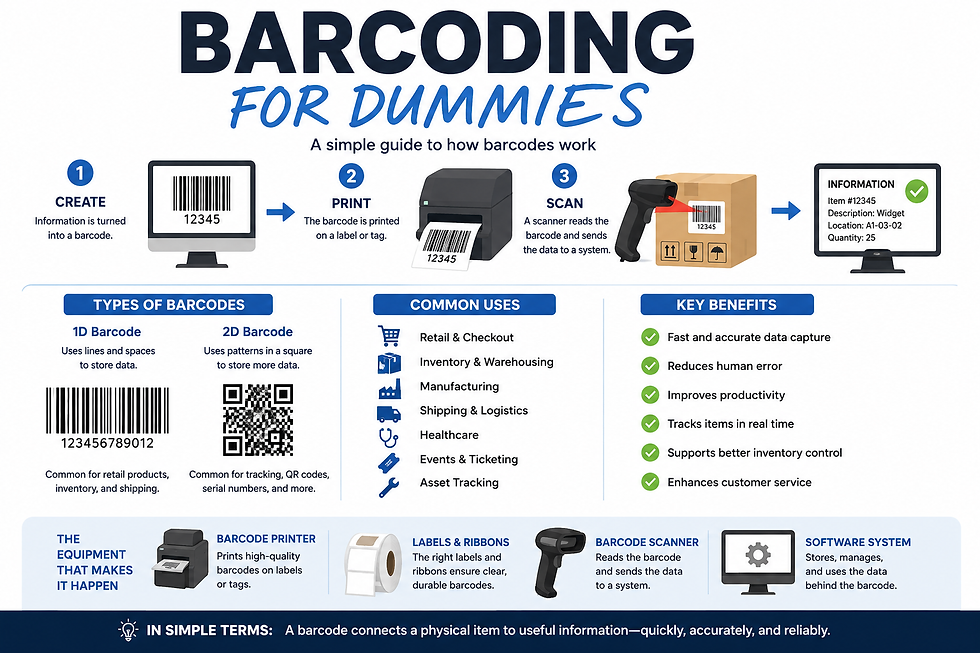
A traditional 1D barcode is limited in how much data it can carry. A 2D barcode, like a QR code or Data Matrix code, can carry much more information in a smaller space.
This shift matters for thermal printing because printing 2D codes requires precision. The dots and squares must be clean, consistent, and scannable. Poor print quality can make a 2D barcode unreadable.
As 2D adoption grows, printer quality, label material, printhead resolution, media selection, and verification become even more important.
Thermal Printers and the Future of Barcoding
The future of barcoding is not just about the symbol. It is about the entire system.
Modern barcode printing now touches:
Cloud-connected printer management
Mobile printing
RFID-enabled labels2D barcodes
Serialized product tracking
Food and pharmaceutical traceability
Warehouse automation
Manufacturing visibility
E-commerce fulfillment
Retail point-of-sale readiness
Thermal printers remain important because businesses still need a reliable way to place digital identity onto physical items.
Whether the label is a simple shipping barcode or a high-resolution 2D code with serialized data, the printer is what turns digital information into something that can move through the real world.
Final Thoughts
The barcode started as an idea to speed up grocery checkout. Today, it is one of the most important technologies in global commerce.
It helps companies track products, reduce errors, improve inventory accuracy, speed up operations, and connect physical items to digital systems.
But the barcode’s success depended on more than the code itself. It needed standards, scanners, software, and reliable printing.
Thermal printers played a major role by making barcode labels practical, affordable, durable, and available on demand. They helped move barcoding beyond the grocery aisle and into warehouses, factories, hospitals, shipping docks, retail stores, and supply chains around the world.
The next chapter is already underway with 2D barcodes, GS1 Digital Link, RFID, cloud-connected printers, and smarter labeling systems.
The barcode may be more than 70 years old, but it is far from finished. It is still evolving, and thermal printing will continue to be one of the technologies that keeps it moving forward.


Comments