


The Printhead Decision: Choosing Between Near-Edge and Flat-Head Thermal Printing

Near-Edge vs. Flat-Head Printheads: What’s the Difference?
In thermal transfer printing, the printhead is one of the most important parts of the printer. It controls how heat is applied to the ribbon and media, which directly affects print quality, speed, ribbon selection, media compatibility, maintenance, and overall cost.
The two most common thermal transfer printhead designs are flat-head and near-edge. Both use heat to transfer ink from a ribbon onto a label, tag, film, or other substrate, but they do it in different ways.
What Is a Flat-Head Printhead?
A flat-head printhead sits in a more horizontal position against the ribbon and media. The heating elements are typically located more toward the center of the printhead. As the ribbon and media pass under the head, the ribbon stays in contact with the media for a slightly longer distance before separating. This gives the ink time to transfer and cool before the ribbon peels away.
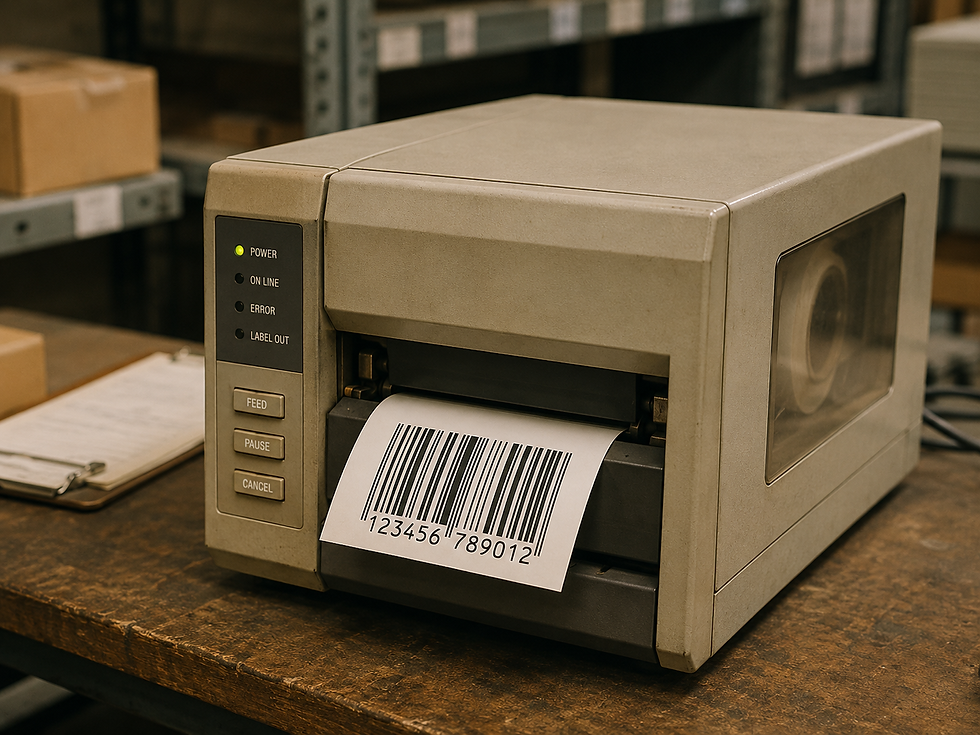
Flat-head technology is the most common design used in traditional barcode label printers. It is widely used for warehouse labels, shipping labels, product labels, asset tags, compliance labels, and general-purpose thermal transfer printing.

What Is a Near-Edge Printhead?
A near-edge printhead, sometimes called a corner-edge or floating-head printhead, is angled so the heating elements are closer to the edge of the printhead. The ribbon and media separate almost immediately after heat is applied. Because of that fast separation, near-edge printing requires ribbon that releases ink very quickly.
Near-edge printheads are common in higher-speed applications, flexible packaging, product coding, and certain industrial label applications where speed, media flexibility, or ribbon-save capability is important.

The Main Difference
The biggest difference is where and how the heat is applied.
With a flat-head printhead, the ribbon and media travel together under the printhead for a longer dwell time. The ink transfers and cools before the ribbon separates.
With a near-edge printhead, the printhead applies heat closer to the edge, and the ribbon separates almost immediately after transfer. This allows faster printing, but it also requires the right ribbon and media combination.
Advantages of Flat-Head Printheads
Flat-head printheads are popular because they are dependable, widely available, and cost-effective.
One of the biggest advantages is media and ribbon availability. Flat-head printers can typically use standard wax, wax/resin, and resin ribbons. These ribbons are widely available and usually less expensive than near-edge ribbons. That makes flat-head a strong choice for companies printing large volumes of standard labels.
Flat-head printers are also excellent for general barcode quality. Because the ribbon and media remain together slightly longer, the transfer process is stable and consistent. This makes flat-head printers a good fit for detailed barcodes, small text, shipping labels, inventory labels, and product identification.
Another advantage is hardware cost. Flat-head printers are typically less expensive than comparable near-edge printers. They are also more common, which usually means more options, more compatible supplies, and easier support.
When to Use a Flat-Head Printhead
Use flat-head printing when your application involves standard labels, traditional barcode printing, and a need to control cost.
Flat-head is usually the better fit for:
Warehouse labels
Shipping labels
Retail labels
Product labels
Asset tags
Healthcare labels
Manufacturing labels
Compliance labels
Applications where media and ribbon cost matter
Applications where print speed is important but not extreme
If you are printing common label materials like paper labels, polypropylene labels, polyester labels, or standard thermal transfer tags, a flat-head printer is often the practical and cost-effective choice.
Advantages of Near-Edge Printheads
Near-edge printheads are designed for speed and flexibility.
Because the heat is applied near the edge of the printhead and the ribbon separates quickly, near-edge printers can often run faster than flat-head printers. Some thermal transfer overprinting applications can run much faster than traditional tabletop label printing, especially in packaging environments.
Near-edge technology is also strong when printing on different or thicker substrates. The angled “floating” head design can help with certain films, flexible packaging, tags, and specialty materials. This is one reason near-edge is often used in food packaging, pharmaceutical packaging, medical device packaging, and other coding applications.
Another advantage is ribbon-save capability. In some near-edge systems, the printer can stop ribbon movement when there is no image to print. This reduces ribbon waste, especially when printing small date codes, lot codes, or intermittent images on packaging.
When to Use a Near-Edge Printhead
Use near-edge printing when speed, packaging integration, or specialty media are the priority.
Near-edge is usually the better fit for:
Flexible packaging
Film printing
Product coding
Date codes and lot codes
High-speed production lines
Thicker tags or specialty substrates
Applications that benefit from ribbon-save
Printing where the image is small but repeated frequently
Packaging lines where downtime and speed matter more than lowest hardware cost
Near-edge is not always the cheapest option upfront, but it can be the right option when production speed, uptime, and ribbon efficiency are more important than initial hardware price.
Cost Differences: Hardware
In general, flat-head printers cost less upfront. They are more common and are available in a wide range of desktop, industrial, and high-performance models. A typical industrial flat-head printer may fall anywhere from the low thousands to several thousand dollars depending on print width, DPI, options, connectivity, cutter, peeler, RFID, and duty cycle.
Near-edge printers typically cost more because the printhead design, ribbon control, and target applications are more specialized. Current online listings show near-edge industrial printers commonly in the mid-$2,000 to $3,000+ range depending on configuration, width, DPI, and options. For example, BarcodeFactory lists multiple Toshiba near-edge industrial models around roughly $2,490 to $3,408 depending on configuration.
A simple way to think about it:
Category | Flat-Head | Near-Edge |
Hardware cost | Usually lower | Usually higher |
Printer availability | Very common | More specialized |
Ribbon cost | Usually lower | Usually higher |
Media flexibility | Strong for standard labels | Strong for specialty/packaging materials |
Speed | Good | Often faster |
Best value | Standard labels and barcodes | High-speed or specialty applications |
Media and Ribbon Differences
This is one of the most important points: the media and ribbon are not always interchangeable.
Flat-head printers typically use standard thermal transfer ribbons: wax, wax/resin, and resin. These ribbons are designed for the longer contact time and slower separation found in flat-head printing.
Near-edge printers require near-edge ribbons designed for fast ink release. These ribbons are often formulated differently so the ink transfers quickly as the ribbon separates immediately after heat is applied. Using the wrong ribbon can cause poor print quality, smearing, weak barcodes, buildup, or printhead wear.
The media can also be different. Flat-head is commonly used for pressure-sensitive labels, paper labels, synthetic labels, and general-purpose thermal transfer media. Near-edge can print standard labels too, but it is especially useful with films, flexible packaging, thicker stocks, and specialty substrates where high-speed transfer and fast separation are needed.
Which One Should You Choose?
Choose flat-head if your goal is reliable, cost-effective barcode and label printing with widely available ribbons and media.
Choose near-edge if your goal is faster production, flexible packaging, specialty substrates, or ribbon savings in applications where only a small amount of information is printed repeatedly.
The wrong choice usually shows up later as higher consumable cost, poor print quality, ribbon issues, media compatibility problems, or unnecessary hardware expense.
Final Thoughts
Flat-head and near-edge printheads both have a place in thermal transfer printing. Neither is automatically better. They are built for different use cases.
Flat-head is the workhorse. It is practical, common, cost-effective, and ideal for standard barcode and label printing.
Near-edge is the specialist. It is faster, more flexible for certain substrates, and better suited for packaging lines and high-speed production environments.
Before choosing between the two, ask:
What material am I printing on?
How fast does the line need to run?
How durable does the image need to be?
Am I printing full labels or small codes?
What ribbon does the application require?
Is upfront hardware cost or production efficiency more important?
The best solution is not just about the printer. It is about matching the printhead technology, ribbon, media, speed, and application so the system performs reliably in the real world.

Comments